
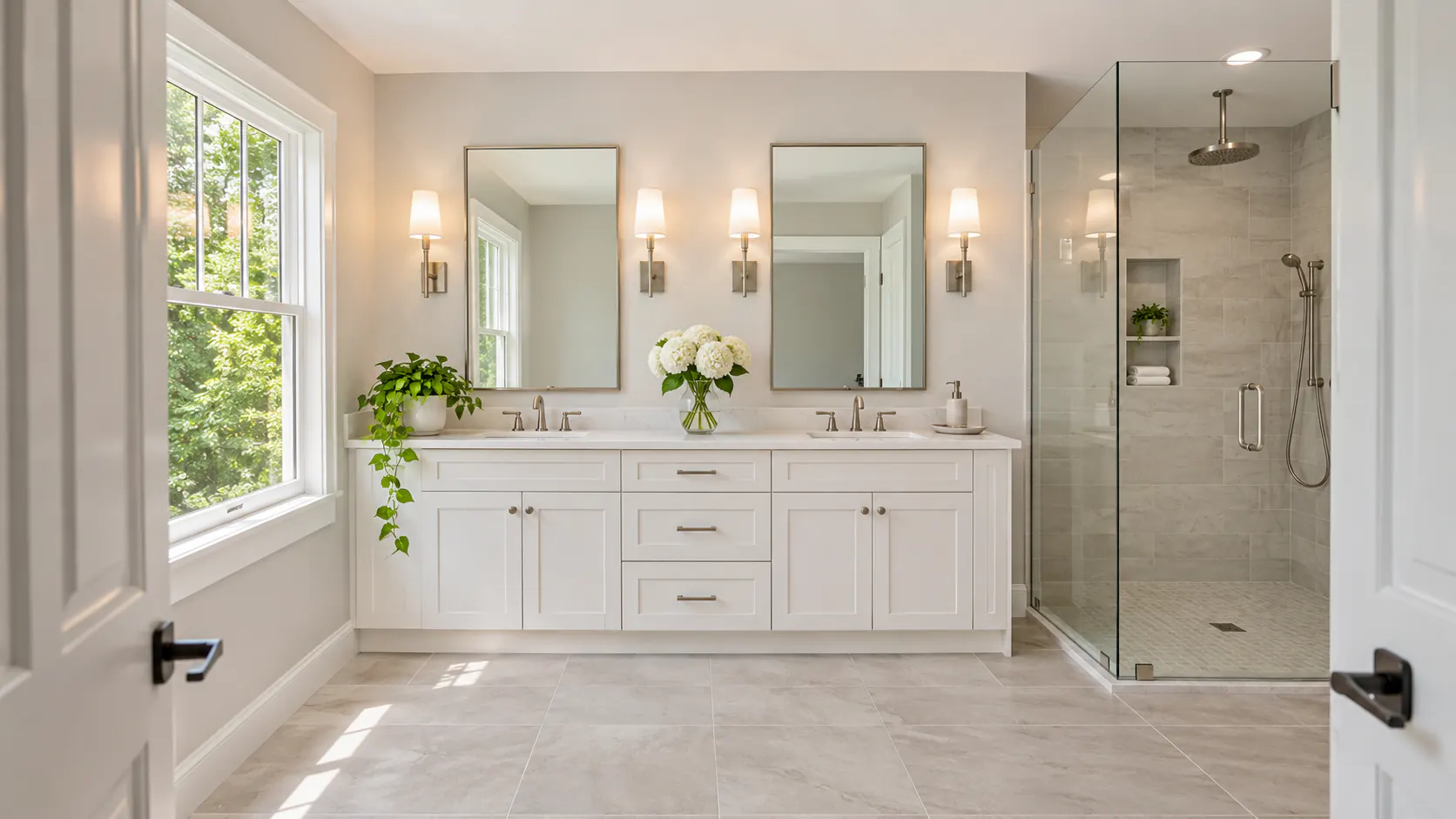
Porcelain tile and luxury vinyl plank are the two floors most Atlanta homeowners shortlist for a bathroom, and both are routinely sold as waterproof. The difference that matters is not the label on the box but how each floor behaves at the seams, edges, toilet and tub, and what it asks of the subfloor underneath.
A useful tile vs LVP bathroom comparison for an Atlanta home weighs the room, the water risk, the structure below and how long you plan to own the home. This guide covers each factor honestly, including where LVP is the smarter pick and where porcelain tile is worth the extra work.
Tile vs LVP Bathroom Atlanta: The Short Answer
Porcelain tile is usually the better floor for primary bathrooms, curbless showers and any bath where water reaches the floor often. Luxury vinyl plank is often the smarter choice for powder rooms, kids' baths, basement baths and rentals, where warmth, speed and budget matter more. Either one works only as a complete, water-managed system.
Most bathroom floor decisions come down to three questions: how much water reaches the floor, what the structure underneath can support and how long the floor needs to last. A primary bath with a big walk-in shower and owners who plan to stay points toward porcelain. A half bath off the foyer, a basement bath on a slab or a rental that must turn over quickly often points toward LVP.
Neither material is the best bathroom floor in every house. Porcelain tile vs luxury vinyl is really a comparison of two installation systems, and the table below shows where each one leads.
| Factor | Porcelain tile | LVP |
|---|---|---|
| Water on the surface | Tile is unaffected; grout and substrate need a membrane plan | Core will not swell; seams and edges can let water under |
| Subfloor demands | Stiff, flat and properly prepared | Very flat; high spots telegraph through |
| Feel underfoot | Hard and cool unless heated | Warmer, softer and quieter |
| Scratches and dents | Excellent scratch resistance; edges can chip | Resists scuffs; can dent under point loads |
| Cleaning | Grout lines need regular attention | Simple; no flooding, steam only if approved |
| Shower floors | Yes, over a waterproofed, sloped pan | No, not a shower-pan material |
| Installation disruption | Longer; mortar and grout need cure time | Often faster once the subfloor is ready |
Waterproof Product vs a Water-Managed Floor
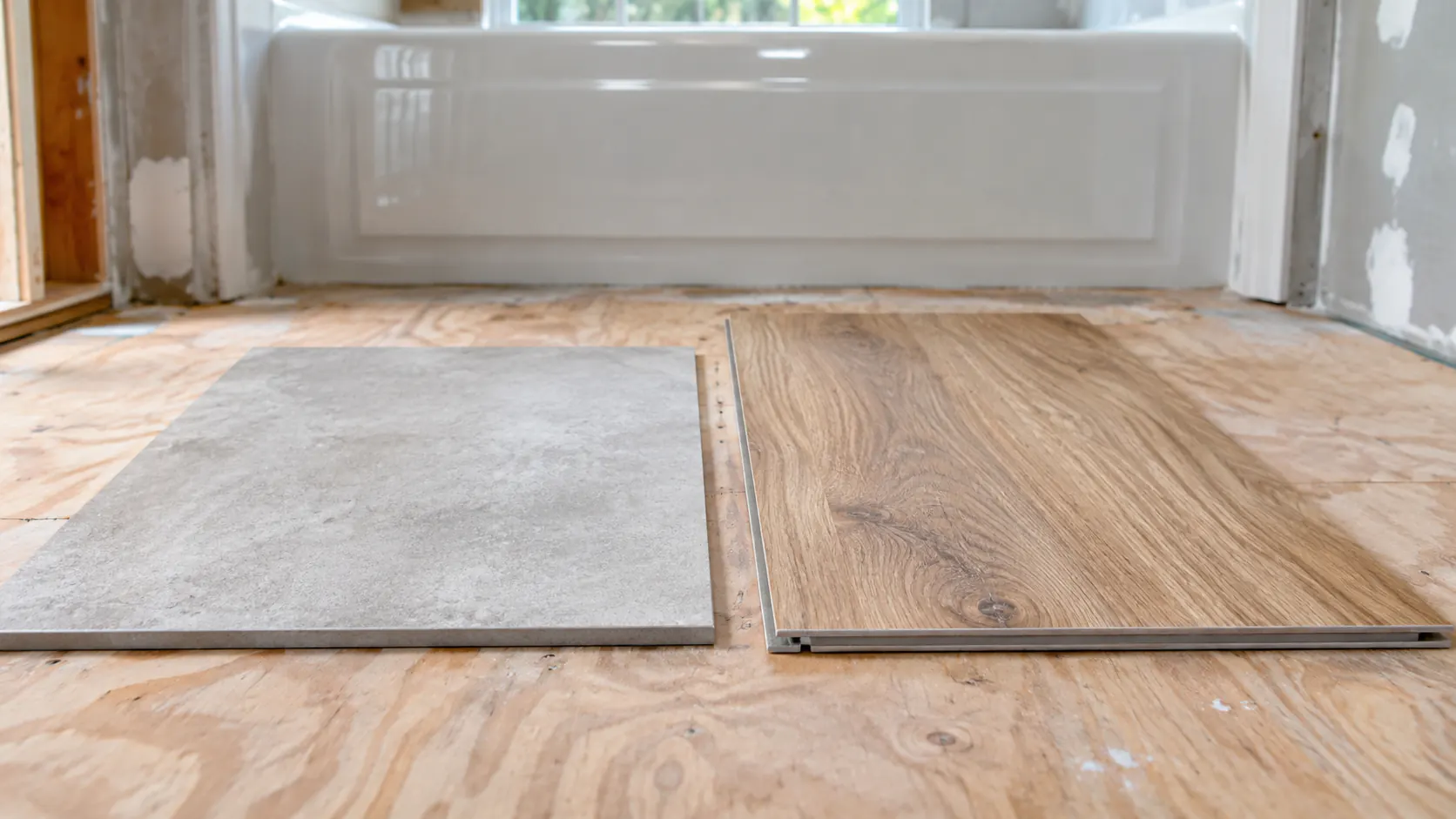
Waterproof bathroom flooring is one of the most misunderstood phrases in remodeling. On a product box, “waterproof” usually means the plank or tile itself will not swell or break down when wet. It does not mean the installed floor keeps water away from the subfloor; that job belongs to the seams, perimeter, penetrations and whatever sits below. The gap between label and installed floor is the heart of the tile vs LVP decision for any bathroom.
Bathroom water, whether curtain drips, a weeping supply line, a failing wax ring or a full overflow, finds weak points first: the tub joint, the wall gap, the cut around the toilet flange, an open plank seam or a cracked grout joint.
How a tile floor manages water
Porcelain absorbs very little water, so the tile itself shrugs off a flood. Cement-based grout is porous, though, and water can pass through it to the substrate. A good bathroom installation treats the floor as a system, often with a sheet or liquid-applied waterproofing membrane carried up at the walls and tied into the tub where the design calls for it. Perimeter joints get flexible sealant rather than hard grout, so normal movement does not crack open a path for water.
How an LVP floor manages water
Rigid-core LVP will not swell when wet, a genuine advantage over laminate and wood. But most bathroom LVP floats, with a small expansion gap at every wall, tub and cabinet. Water that reaches that gap or an open seam can travel under the planks, out of sight and slow to dry. Manufacturers that approve bathrooms usually specify how to treat the perimeter in wet areas, often with flexible sealant at the tub and toilet. Our luxury vinyl plank installation follows those product-specific instructions.
The difference shows up after an overflow. On tile over a membrane, water stays on top and gets mopped up. On floating LVP, the planks may be fine while the subfloor beneath them stays damp, which can mean lifting part of the floor to dry it.
Subfloor Needs: Stiffness for Tile, Flatness for LVP
Many tile vs LVP debates end once someone checks the subfloor, because each material fails differently when the substrate is wrong.
What porcelain tile needs underneath
Tile is rigid and grout is brittle, so the structure below must be stiff. A wood-framed floor that flexes slightly may feel fine under vinyl, but that movement can crack grout and eventually tiles. Older intown houses, from Kirkwood bungalows to early Virginia-Highland homes, sometimes have joists notched for plumbing decades ago, which is worth checking first.
Tile also needs a flat, properly prepared substrate and a suitable underlayment, such as cement backer board, an uncoupling or waterproofing membrane, or a combination, as the tile maker requires. Large-format porcelain demands a flatter surface than small tile, or neighboring edges sit unevenly, a defect called lippage. On slabs, a crack-isolation membrane helps keep hairline shrinkage cracks from mirroring into the floor. Professional tile flooring installation starts with that assessment, not with the tile.
What LVP needs underneath
LVP tolerates a little flex but not bumps. A high spot or ridge can telegraph through as a visible hump, and a low spot lets the plank flex at its click joint with every step, which can squeak, open seams or break joints over time. Flatness to the manufacturer's tolerance is the main requirement, along with a clean, dry, sound subfloor and any specified underlayment.
Old floors, layers and finished height
Many bathrooms already have old floors stacked on the original subfloor. Some LVP products can go over flat, well-bonded tile, while new tile normally needs old layers removed down to a sound base. Removing layers also exposes hidden water damage and gives control over finished height at the door and tub.
Not sure what is under your bathroom floor?
We can check the subfloor, the structure and the existing layers during a free in-home estimate, then explain which floor your bathroom can truly support.
Book a Free Bathroom Floor Estimate →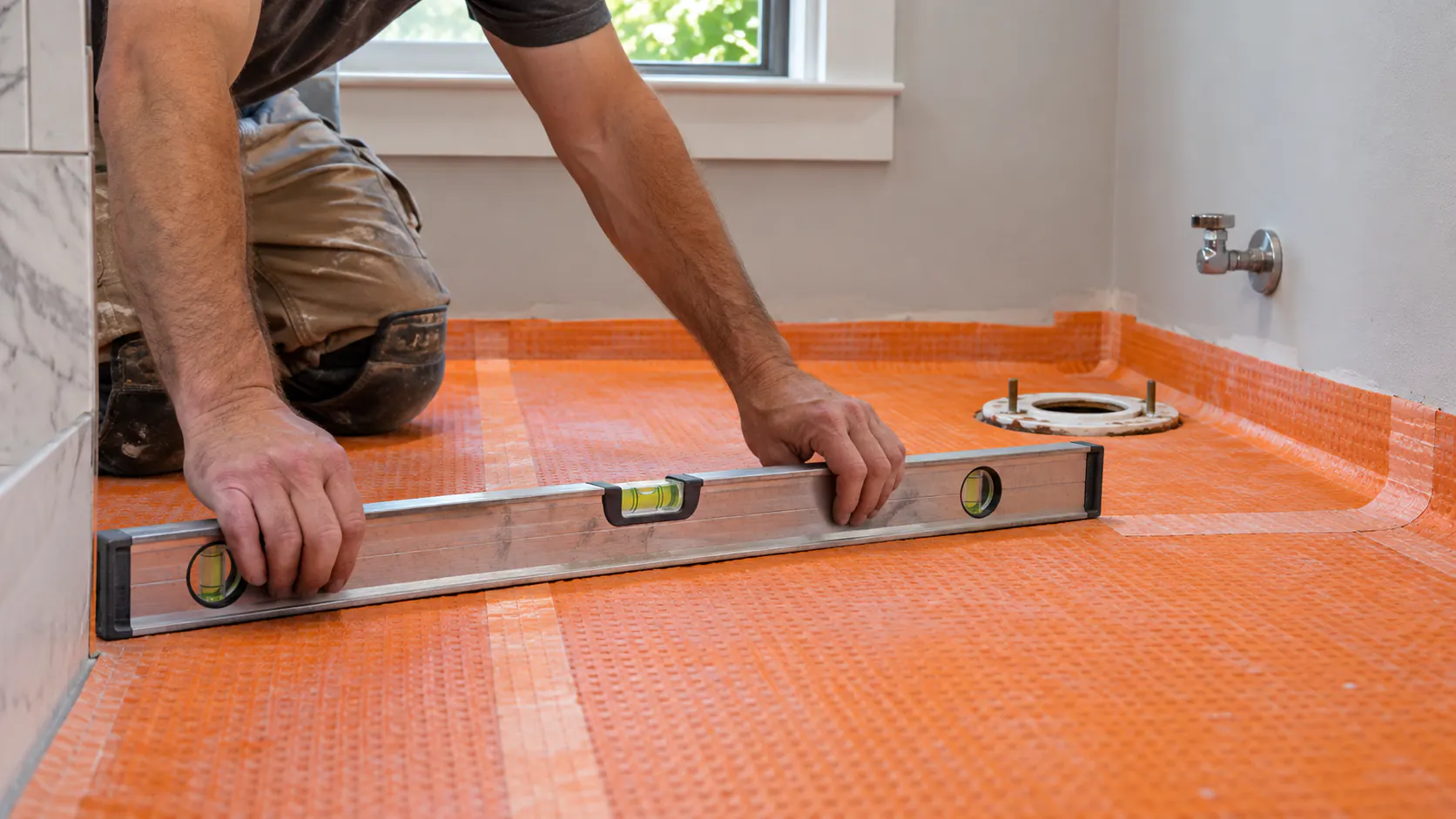
Comfort, Warmth and Sound Underfoot
Cold tile mornings and radiant heat
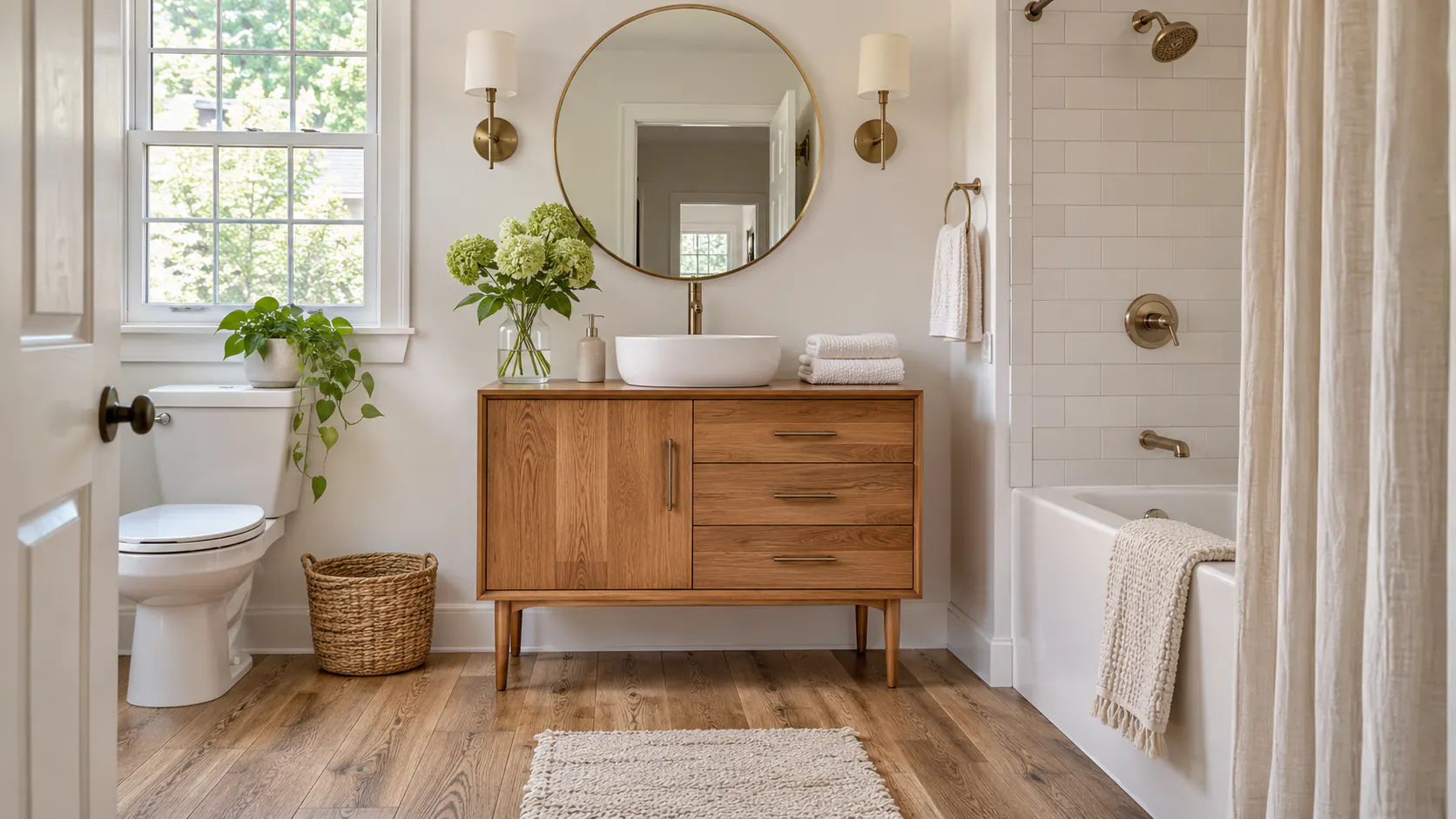
Porcelain feels cool because it draws heat from bare feet quickly. During a sticky Atlanta July that can be pleasant; on a January morning over a crawl space or basement slab, it is the most common complaint about tile. LVP feels noticeably warmer at the same room temperature, one reason it is popular in kids' baths and basements.
An electric radiant mat under tile can make the coldest floor in the house the most comfortable, and some LVP products allow radiant heat within surface-temperature limits. Our guide to heated bathroom floors in Atlanta covers which floors work over heat and why the electrical side belongs to a licensed electrician and the local permit office.
Sound and standing comfort
Tile is solid underfoot but loud when something hits it, and a dropped glass bottle may not survive. Floated rigid-core LVP can sound slightly hollow or clicky, especially over an uneven subfloor or the wrong underlayment; an attached pad helps, and glue-down vinyl feels more solid. A mat at the vanity helps on either floor, but some rubber backings can discolor vinyl, so check the care guidance first.
Durability: Scratches, Dents and Heavy Vanities
Porcelain: hard surface, brittle edges
Porcelain resists scratches from grit, pet nails and shifted stools better than almost any residential floor, and color-body tile disguises small chips. Its weakness is impact: a heavy bottle or tank lid dropped on an edge can chip or crack a tile. A damaged tile can be replaced if spares from the same lot were kept, though blending new grout takes care.
LVP: scuff-resistant, dent-prone under point loads
Quality LVP shrugs off daily traffic, but the red clay grit kids and dogs track in from Atlanta yards will leave fine marks over time. Concentrated weight is the bigger issue: narrow vanity legs, a metal step stool or the feet of a filled freestanding tub can dent softer vinyl. Our guide on how to choose LVP flooring explains how wear layer and core construction affect that.
Heavy vanities, stone tops and freestanding tubs
Floating floors must move slightly with temperature, so most manufacturers say fixed cabinets should not sit on them. A built-in vanity usually goes in first, and the LVP runs up to it with the required gap, finished with trim or sealant. Tile has no such limit and often runs under the vanity, which makes a future swap easier. For a cast-iron or stone tub on vinyl, confirm the product allows that load and whether protective pads are recommended.
Slip Resistance and Everyday Cleaning
Choosing a floor that grips when wet
No hard floor is slip-proof with soap and water on it, which matters most in baths shared by young children or older adults. With tile, finish matters more than material: matte and lightly textured porcelain grips better than polished or glossy tile, and smaller tiles add more grout lines underfoot. With LVP, choose an embossed texture approved for wet areas over a smooth, high-sheen surface, and ask for the floor-use slip rating of any product you consider.
Grout lines vs vinyl seams
Grout is the maintenance part of a tile floor. In a humid bathroom it collects soap residue and body oils, and light grout shows them first. Cement grout benefits from a penetrating sealer on the grout maker's schedule, while high-performance and epoxy grouts resist staining with less upkeep. Our article on the best tile for Atlanta kitchens and bathrooms covers finishes, sizes and grout choices.
LVP is simpler: sweep, then damp-mop with an approved cleaner. Avoid flooding the floor, since water pooled at seams is exactly what you want to keep out, and skip steam mops and abrasive pads unless the care guide allows them.
On both floors, humidity is the hidden enemy. A bathroom without a working, properly ducted exhaust fan stays damp through Atlanta summers, feeding mildew in grout and along caulk lines.
See porcelain and LVP side by side in your bathroom
We bring samples to your home so you can compare texture, color and feel under your own lighting, next to your vanity and tub.
Schedule My Free In-Home Estimate →Installation Time, Floor Height and Fixtures
How long each floor disrupts the bathroom
Tile is a sequence: demolition, subfloor repair, backer board or membrane, setting, mortar cure, grouting, grout cure and sealing if required. Each wait depends on the products, temperature and humidity, so even a small bathroom often spans several visits. LVP is often completed much faster once the subfloor is flat and dry, because planks lock together and can usually be walked on right away. For either floor, what demolition uncovers and any plumbing work set the real timeline.
Floor height at doors, tubs and hallways
Tile, mortar and backer board or membrane build more height than most LVP. That can mean trimming the door and adding a transition to the hallway hardwood or carpet, and at an alcove tub the finished floor should leave a clean, sealable joint along the apron. Settle transitions before ordering material to avoid awkward ramps.
Toilets and vanities: before or after the floor?
In most remodels, the toilet comes out and is reset on the finished floor, so the flange must end up at the right height for a proper seal; when new layers change that, a plumber decides whether to raise, extend or reset it. With LVP, planks are cut around the flange, and the product instructions decide whether the toilet may rest on a floating floor and how the cut is sealed. Vanities follow the logic above. Our guide to planning a bathroom remodel in Atlanta shows how flooring fits the larger sequence.
Before demolition day, confirm these details with your installer:
- Who removes and resets the toilet, and how flange height will be handled.
- Whether the vanity goes in before or after the floor.
- The finished floor height at the door, tub and any floor register.
- The transition profile where the bathroom meets the hallway.
- How the perimeter, tub edge and flange cut will be sealed.
- How many spare tiles or planks will be left for future repairs.

Shower Floors and Wet Zones
The shower is where the two materials stop being interchangeable.
LVP is not a shower-pan material
Luxury vinyl plank is a floor covering for rooms that get splashes, not a surface that stays under running water. It cannot be sloped to a drain, and its seams are not built to hold back standing water. A walk-in shower floor will be tile, stone or a manufactured base, even when the rest of the room is vinyl.
A tile shower depends on what is under it
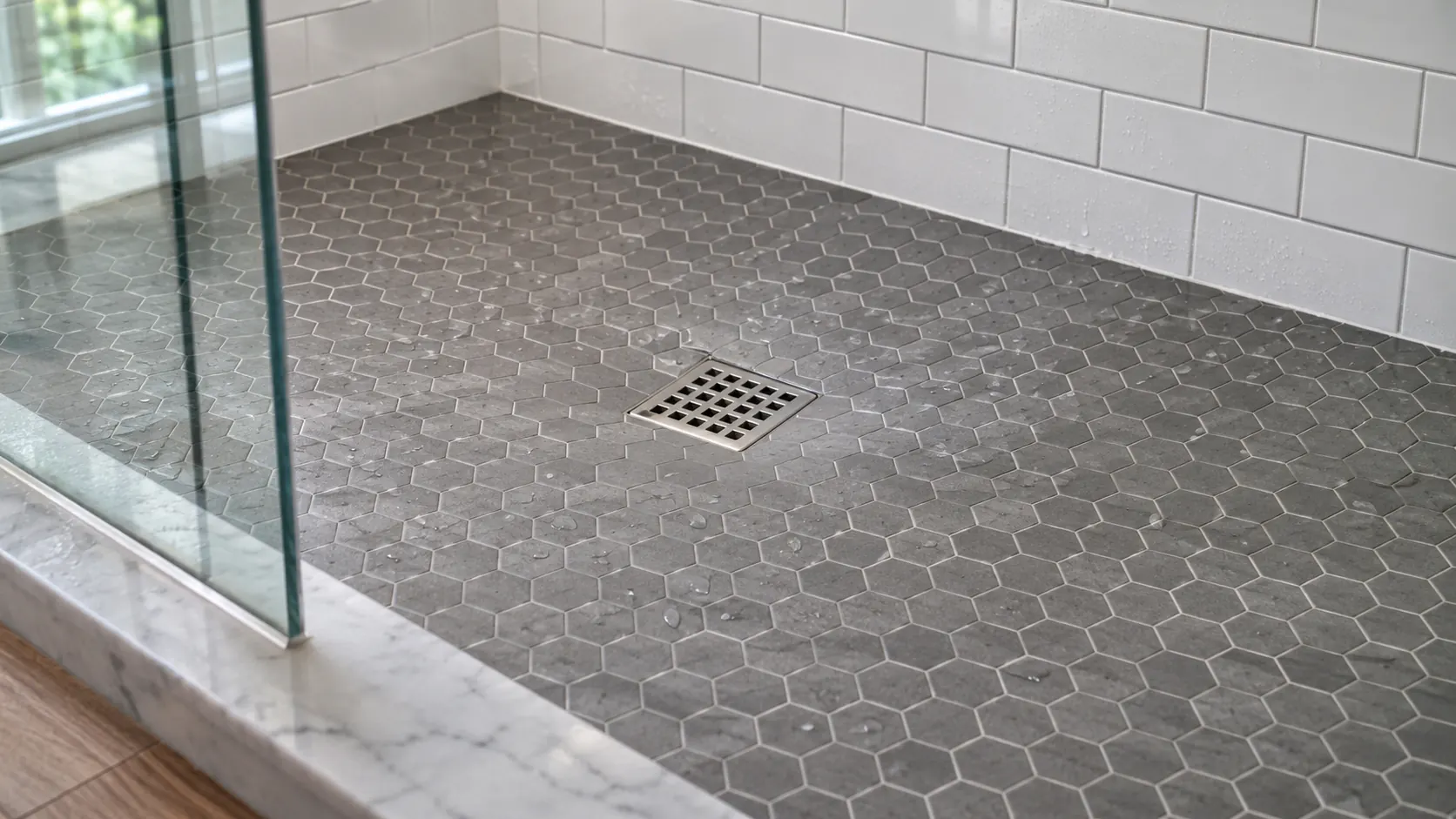
In a tiled shower, tile and grout are the finish, not the waterproofing. The watertight layer is the pan or membrane below, with proper slope and carefully integrated drain and curb details. Small matte mosaics follow that slope and give bare feet better grip, while large shower-floor tiles usually call for a linear drain. Our guide to shower waterproofing in Atlanta explains methods, slope, drain integration and testing before tile.
A tile shower beside an LVP bathroom floor is common and works well when the threshold is detailed for water dripping off the door or curtain. A curbless shower is different: the floor near the entry becomes part of the wet zone, which in practice makes porcelain tile the floor for the whole room.
Which Bathroom Suits Which Floor?
One house can reasonably have tile in one bathroom and LVP in another, which is why the tile vs LVP question is best answered room by room.
Primary bathroom
Porcelain tile is the usual recommendation. Primary baths get the most water, often include a large shower or freestanding tub, and are where owners expect the longest-lasting finish. Add radiant heat if cold tile is the main objection.
Kids' and hall bathrooms
Bath-time splashing, wet towels and the occasional overflowing toilet favor tile over a membrane in the long run. LVP with a carefully sealed perimeter is still a reasonable, warmer and quicker option, especially when the budget is spread across several rooms.
Powder rooms
With no tub or shower, a powder room carries the lowest water risk in the house, so style can lead. A patterned tile makes a strong statement in a small footprint, while LVP matched to the hall floor makes a tight room feel larger.
Basement bathrooms
Many Atlanta basements sit on slabs that feel cool and can carry ground moisture. Porcelain tolerates moisture well over a prepared slab, while LVP adds warmth after moisture testing and any vapor protection the manufacturer requires. Fix any history of water problems first.
Rental and investment bathrooms
Owners often choose LVP for rentals because it installs quickly, resists everyday wear and lets a damaged plank be replaced without a tile setter. Tile still makes sense in showers and wherever tenants are hard on finishes. Try combinations in our bathroom visualizer, and see how our kitchen and bathroom remodeling team coordinates floors with showers, tubs and vanities.
Cost Drivers, Resale and Your Decision
What drives the cost of each floor
Every bathroom flooring estimate depends on more than material price. Tile carries more labor: substrate work, membranes, layout, cutting, grouting and cure time, with large-format tile, intricate patterns, mosaics and heating mats adding more. LVP material quality varies widely, but installation is simpler, so preparation becomes the main variable.
Both share hidden drivers: removing old layers, subfloor repair around the toilet, leveling, flange changes, transitions, and removing and resetting the vanity and toilet. Our breakdown of bathroom remodel cost in Atlanta shows how those items add up.
Style and resale
In many Atlanta neighborhoods, a tiled primary bath reads as a finished, long-term renovation, while wood-look LVP is widely accepted in secondary baths and basements. Porcelain also offers more design range, from stone-look slabs to patterned and handmade-look tile. If you plan to sell soon, match the primary bath to the rest of the house and nearby homes.
Before you settle the tile vs LVP question for each bathroom in your home, answer these:
- How often does water actually reach the floor in this bathroom?
- Is there a shower, and is it curbed or curbless?
- Does the floor flex underfoot, and what is the subfloor made of?
- Is the room over a crawl space, a slab or another living space?
- Who uses it: adults, young children, older relatives, guests or tenants?
- How will finished height work at the door, tub and toilet flange?
- Will the vanity sit on the floor, or will the floor stop at the vanity?
- How long do you plan to stay, and who is likely to buy the home next?
If doubt remains, a site visit settles it, because stiffness, flatness and moisture history are easier to judge in person than from photos.
Get a clear answer for your bathroom floor
We will look at the room, the subfloor and how your household uses it, then recommend porcelain tile, LVP or a combination, with professional installation either way.
Get My Free Estimate →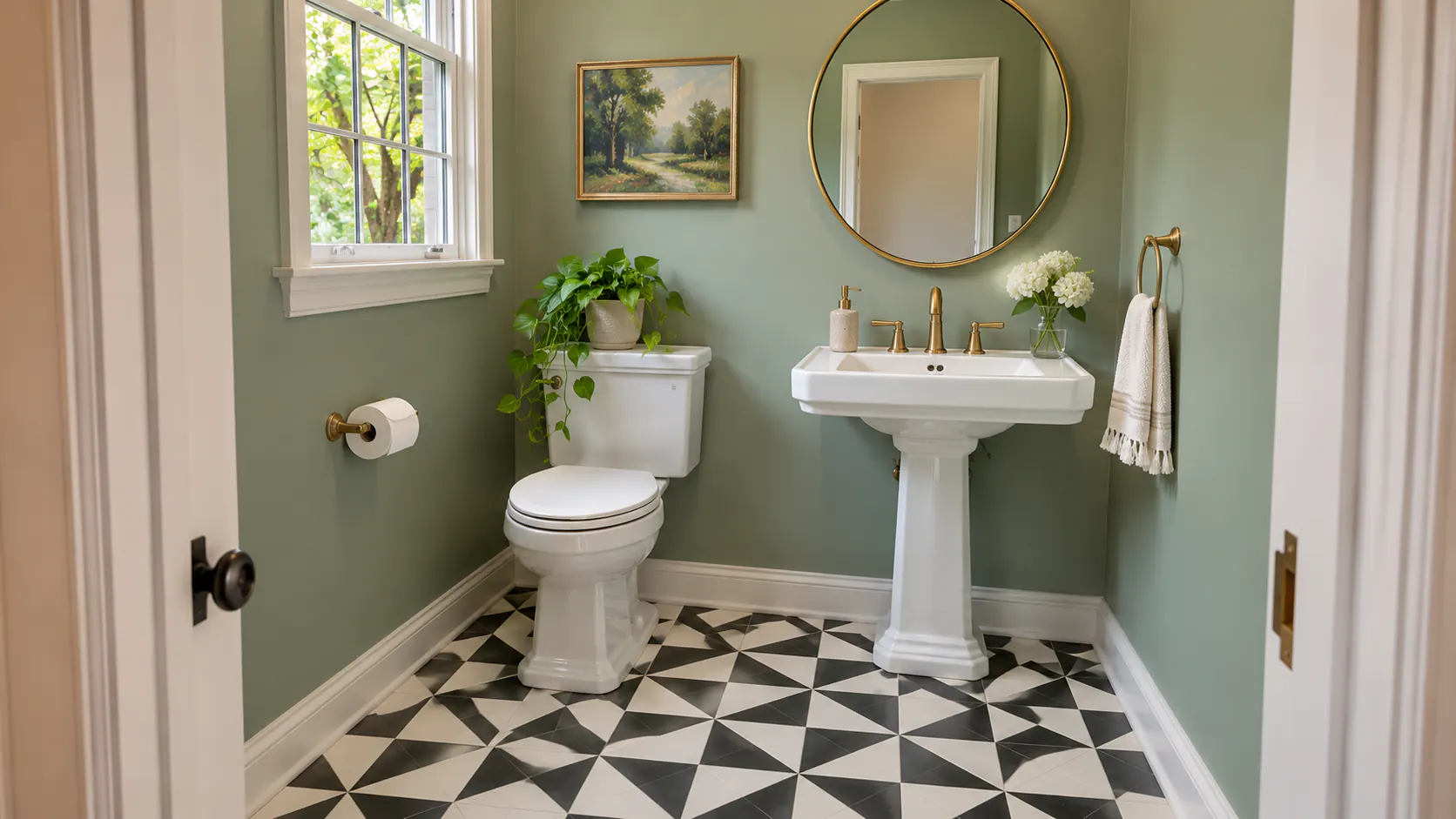
Frequently asked questions
Is LVP really waterproof enough for a bathroom floor?
Rigid-core LVP will not swell when it gets wet, so splashes and spills do not hurt the planks themselves. The risk is water slipping under the floor at seams, the perimeter gap and the toilet cut, so wet-area installation details matter as much as the product.
Can LVP be installed over existing bathroom tile?
Some LVP products allow it when the old tile is flat, well bonded and crack-free, sometimes after deep grout lines are skim-coated. Check the added height at the door and toilet flange, and make sure no water damage is hiding underneath.
Should the toilet sit on top of the new floor?
Usually, yes: the toilet is reset on the finished floor with the flange adjusted to the new height. On floating LVP, follow the product rules for the toilet and the flange cut.
Is tile or LVP better for resale in Atlanta?
Porcelain tile is the expected finish in many primary bathrooms, Quality LVP is widely accepted in secondary baths, basements and rentals, so fitting the floor to each room matters more than a single rule.
Does porcelain tile need to be sealed?
Most porcelain tile does not need a sealer, but cement-based grout usually benefits from one, reapplied as the grout maker recommends. Epoxy and some high-performance grouts are designed to resist stains without routine sealing.
Which feels warmer underfoot, tile or LVP?
LVP feels warmer to bare feet at the same room temperature. Porcelain feels cool on its own, but over an electric radiant mat it can become the most comfortable floor in the house.
Can I use LVP in a basement bathroom?
Often, yes, once the slab has been tested for moisture and any vapor protection the manufacturer requires is in place. Fix any history of leaks first, and consider porcelain tile where water exposure is likely.
Published and reviewed November 10, 2026. Manufacturer instructions, local codes and the conditions found on site control every bathroom floor installation.
Editorial references: The Ceramic Tile Foundation offers consumer information on choosing and caring for ceramic and porcelain tile, the National Kitchen & Bath Association provides bathroom planning and design guidance, and the EPA moisture-control guide explains how buildings manage water and humidity. These resources provide context; product instructions and site conditions control the final work.